
Best Surfaces for Mini UVDTF: 7 Materials That Work
Table of Contents
- What Makes a Surface Compatible With Mini UVDTF
- 7 Best Hard Surfaces for UV DTF Transfers
- Surfaces to Avoid With Mini UVDTF Transfers
- How to Apply Mini UVDTF Transfers Step by Step
- UV DTF Transfer Durability Test: How Long They Really Last
- Common Mistakes That Ruin Mini UVDTF Applications
- Removing Mini UVDTF Transfers Without Damaging the Surface
- Conclusion
- Frequently Asked Questions
Last Updated: September 15, 2026
What Makes a Surface Compatible With Mini UVDTF
A surface works with mini UVDTF when it is non-porous, smooth, and clean enough for the cured resin to bond. The best surfaces share three traits: low absorbency, a hard finish, and surface energy high enough to hold a pressure-sensitive film.

Mini UVDTF is a UV-curable transfer film: the design sits in a layer of ink already cured into a flexible resin before it reaches you. You are not printing anything, you are bonding a finished decal to a substrate with pressure and time.
Because the ink is already polymerized, the bond depends entirely on contact. A porous surface pulls the adhesive into its structure before you can press the film flat.
Surface Energy and Why It Controls Adhesion
Surface energy measures how readily a liquid or adhesive spreads across a solid. High-energy surfaces pull adhesive in and hold it; low-energy surfaces push it away. The unit is the dyne per centimeter (dyn/cm), and the practical threshold most adhesive makers cite is roughly 38 dyn/cm: below that, a pressure-sensitive adhesive struggles to wet out and grab.
Here is where common craft materials land on that scale:
- Glass and glazed ceramic: high energy, typically well above the threshold. Adhesive wets out fast and bonds hard.
- Stainless steel and aluminum: high energy when clean, but oils and mill residue drop the effective reading fast.
- Acrylic (PMMA): moderate-to-high energy. Bonds reliably with a simple alcohol wipe.
- Rigid PVC: moderate energy. Bonds well, but plasticizer migration over time can soften the bond.
- Polypropylene and polyethylene: very low energy, often below 31 dyn/cm. These are the classic "it peeled off overnight" blanks.
- Silicone and PTFE: engineered to be non-stick. No prep will make them hold a decal.
You do not need a lab to test this. Water beads up on a low-energy surface and sheets flat on a high-energy one, if a drop sits in a tight dome on your blank, expect trouble. A dyne test pen gives you a real number if you want one.
Why Prep Chemistry Changes by Material
One cleaning routine does not fit every blank: different contaminants respond to different solvents, and the wrong one leaves its own residue.
- Glass and glazed ceramic: the enemy is dust and fingerprints. A wash with mild dish soap, a rinse, then an isopropyl alcohol (IPA) wipe handles both.
- Stainless steel and aluminum: the enemy is manufacturing oil and machining coolant. IPA alone thins oil but does not lift it. Start with a dedicated degreaser or a warm soapy wash, dry, then follow with IPA.
- Powder-coated metal: you are bonding to the coating, not the metal. The enemy is mold-release and polish residue. A light scuff with a fine abrasive pad, then IPA, gives the adhesive something to bite.
- Acrylic: the enemy is dust and static. IPA alone is fine. Never use acetone or strong solvents, which cloud and craze the plastic (pubmed.ncbi.nlm.nih.gov).
- Rigid PVC: the enemy is mold-release agent from the extrusion process. A warm soapy wash, rinse, dry, then IPA is the safe sequence.
A quick test before you commit: press a piece of transfer tape onto the prepped surface and peel it. If it releases with almost no resistance, your surface is still contaminated. Clean it again.
The Two Failure Modes Surface Energy Predicts
When surface energy is too low, you get adhesive failure: the decal lifts cleanly off the blank, often within a day, leaving little residue. That is a surface problem, not a transfer problem.
When surface energy is fine but the surface is contaminated, you get interfacial failure: the decal holds at first, then lifts at the edges weeks later as the contaminated layer releases. That is a prep problem, which is why the degrease step matters more than the brand of transfer you buy.
7 Best Hard Surfaces for UV DTF Transfers
These seven surfaces cover nearly every small-format project, from keychains to tumblers. Each is non-porous, takes pressure well, and holds a cured resin layer without lifting.
- Acrylic blanks (hotel keychains, charms, tags)
- Stainless steel (tumblers, flasks, pen barrels)
- Powder-coated metal (mugs, water bottles, badge reels)
- Glass (ornaments, jars, flat panels)
- Glazed ceramic (tiles, coasters)
- Rigid PVC and hard plastic (signage, tags)
- Flexible TPU (phone cases, soft-shell items)
Acrylic Blanks and Hotel Keychains
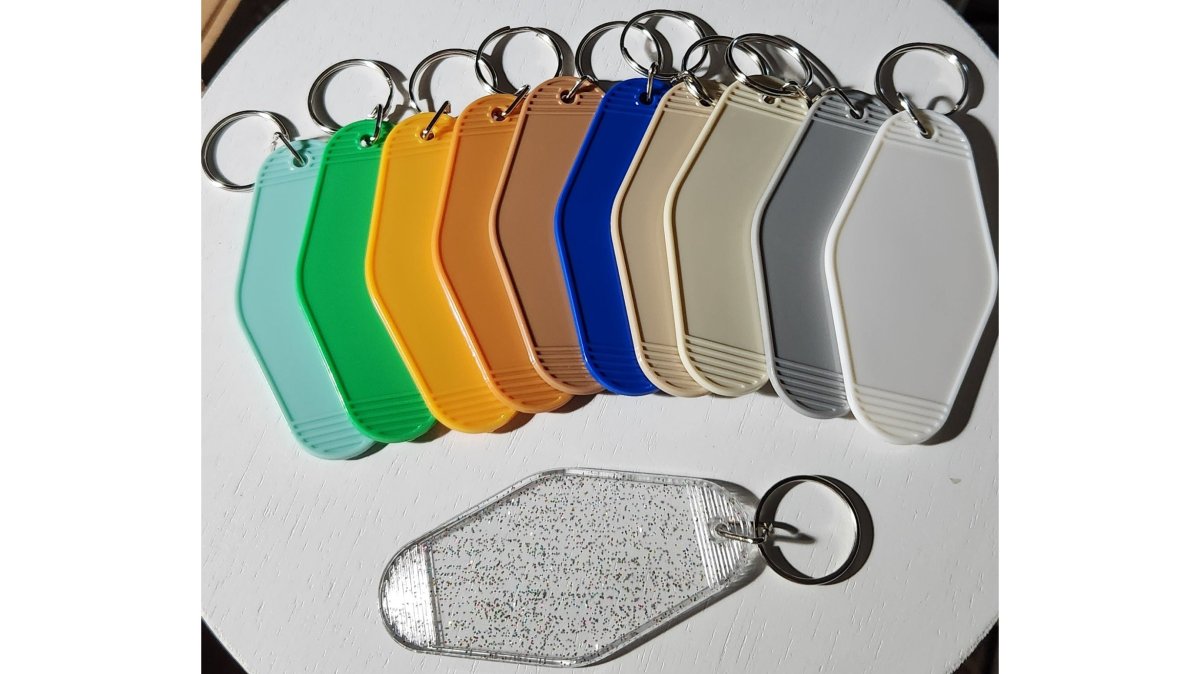
Acrylic is the easiest surface to start with: smooth, non-porous, and it holds a clean edge on a small decal. The acrylic hotel keychains we stock measure 1.5 by 2.5 inches on the face, a near-perfect match for a 2 by 2.5 inch mini UVDTF. Oversized transfers on a small blank mean trimming cured resin, which produces ragged edges and lifted corners. Pair a blank with something like the Faith over Fear mini UVDTF and you have a finished keychain for well under two dollars in materials.

Stainless Steel, Powder-Coated Metal, and Glass
Stainless steel is the durable option: hard, heat-resistant, and it takes a strong bond once degreased. The catch is oil, skin oils and manufacturing residue quietly kill adhesion, so degreasing is not optional.
Powder-coated metal behaves differently: you are bonding to the cured polymer coating, not the metal underneath. That is often better, since powder coat gives the adhesive a slightly textured surface to grip. Just avoid glossy, polished powder coats.
Glass bonds beautifully and looks premium, but it is unforgiving of trapped air, any dust speck shows through as a visible bubble, so it demands the cleanest prep of the three.
| Surface | Prep Needed | Bond Strength | Best For |
|---|---|---|---|
| Acrylic | Alcohol wipe | Strong | Keychains, charms |
| Stainless steel | Degrease + alcohol | Very strong | Tumblers, flasks |
| Powder-coated metal | Alcohol wipe | Strong | Mugs, bottles |
| Glass | Wash + alcohol | Strong | Ornaments, jars |
| Glazed ceramic | Wash + alcohol | Strong | Coasters, tiles |
Surfaces to Avoid With Mini UVDTF Transfers
Skip anything porous, waxy, or heavily textured. Silicone is the clearest example: it is deliberately non-stick, exactly what you do not want under a decal. The same goes for untreated polyethylene, waxed paper, raw wood, unfinished leather, and loose-weave fabric.
How to Apply Mini UVDTF Transfers Step by Step
Material-Specific Prep Guide
UV DTF Transfer Durability Test: How Long They Really Last
How Each Stressor Actually Attacks the Bond
Substrate-by-Substrate Durability Expectations
A Realistic Home Durability Test
Common Mistakes That Ruin Mini UVDTF Applications
Surface preparation decides the outcome. A perfectly applied transfer on a contaminated surface will fail. A decently applied transfer on a properly prepped surface will last.
Removing Mini UVDTF Transfers Without Damaging the Surface
Conclusion
Frequently Asked Questions
What can you put mini UVDTF transfers on?
Mini UVDTF transfers bond best to non-porous, hard surfaces with high surface energy. Acrylic hotel keychains, stainless steel tumblers, powder-coated metal, glass, and some plastics all work well. Barkers Creative Designs sells acrylic hotel keychain blanks sized at 1.5 by 2.5 inches for $0.60 each, which pair directly with their 2 by 2.25 inch mini UVDTF designs at $0.50. Avoid raw wood, uncoated fabric, and silicone because their low surface energy prevents the cured resin from gripping.
Are UV DTF transfers waterproof and permanent?
Once the UV-curable ink is fully cured, the transfer becomes waterproof and resistant to scratching under normal use. Hand washing is fine, but soaking in hot water or running through a dishwasher repeatedly will shorten the decal's life. For best results, let the transfer sit for 24 hours before exposing it to water. A uv dtf transfer durability test on a glass tumbler typically shows the decal holding up for months of daily handling when applied to a properly degreased surface.
How do I apply mini UVDTF transfers to curved surfaces?
Curved surfaces like pens, tumblers, and rounded keychain edges need extra care. Start at the center of the curve and work outward with firm, overlapping strokes using a squeegee or your thumb. Apply steady pressure for 10 to 15 seconds per section. Tight curves under 1 inch in radius will cause wrinkling, so choose flat or gently curved blanks for mini UVDTF designs.
Do I need to prime surfaces before applying UV DTF transfers?
Priming is not required on acrylic, glass, or powder-coated metal. What matters is cleaning. Wipe the surface with isopropyl alcohol and let it dry completely to remove oils and dust. Skipping this step is the number one reason transfers peel at the edges. On raw wood or other porous materials, a clear coat of paint or sealer creates the smooth finish needed for adhesion, but always let it cure fully before applying the transfer.
How durable are UV DTF transfers compared to vinyl?
UV DTF transfers generally outlast standard adhesive vinyl on hard surfaces. The cured resin layer resists scratching, fading, and moisture better than pressure-sensitive vinyl, which can lift at the edges over time. In a uv dtf transfer durability test, transfers on acrylic keychains held up through months of daily pocket wear without peeling. Vinyl still wins on fabric, but for hard surfaces like acrylic, metal, and glass, UV DTF is the more durable choice.