
How to Match Silicone Bead Colors for Craft Projects
Table of Contents
- Gather Your Tools and Prep Your Workspace
- Understand Color Theory for Silicone Bead Colors
- Build Silicone Bead Color Combinations That Work
- Mixing Silicone and Acrylic Beads in One Design
- Account for Lighting and Digital Color Matching
- Are Silicone Beads Safe for Babies? Color and Material Checks
- Test, Adjust, and Finalize Your Color Palette
- Frequently Asked Questions
Last Updated: September 18, 2026
Gather Your Tools and Prep Your Workspace
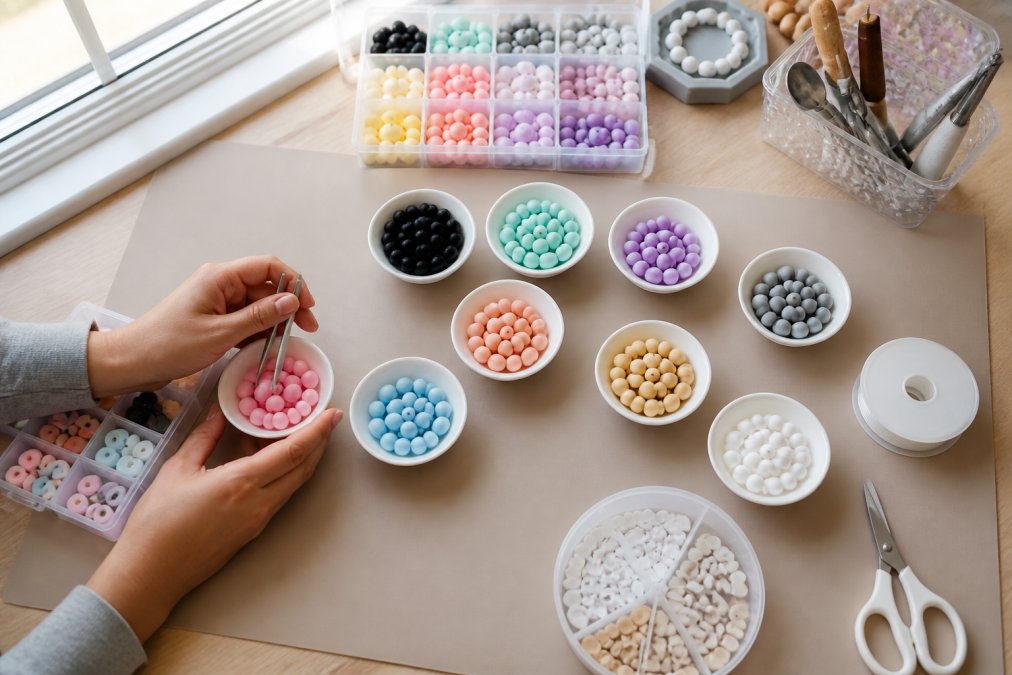
Here is what you need before you start:
- A white or neutral gray mat or felt sheet
- Your full bead stash, sorted by size and color family
- A printed or digital color wheel
- A phone or tablet for photographing layouts
- Small dishes or trays for grouping test combinations
- Your chosen stringing material, wire, or elastic
Understand Color Theory for Silicone Bead Colors
Color theory answers one practical question for bead crafters: which colors look good next to each other?
You need three ideas: hue, saturation, and undertone.
- Hue is the color itself, red, blue, green, yellow.
- Saturation is how vivid or muted it is. Bright teal versus dusty teal.
- Undertone is the subtle base beneath a color. A red can lean warm (orange-based) or cool (blue-based).
Why Silicone Behaves Differently From Other Beads
Silicone is not glass or acrylic, and the finish changes how color theory applies. Three properties matter:
- Matte surface. Silicone scatters light instead of reflecting it, so colors read softer and lighter than the same hue in glossy acrylic. A "navy" silicone bead often looks closer to slate blue next to a glossy navy.
- Semi-translucency. Many solid silicone beads let light through. On a white mat they read one way; against a dark cord or a child's clothing they read darker and cooler. Judge a bead against what will sit behind it.
- Dye-lot variation. Silicone is pigmented in batches, and the same named color can shift between production runs. This is normal, not a defect.
The Color Wheel and Key Schemes
The color wheel turns color matching into a repeatable process. Four schemes cover almost every design.

- Monochromatic: one hue in several shades. Safe, calm, and hard to get wrong.
- Analogous: two or three neighboring hues. Soft and cohesive.
- Complementary: two opposite hues. Bold and high-contrast.
- Triadic: three evenly spaced hues. Playful and energetic.
Standardized Color Naming: Why "Dusty Rose" Is Not a Color
This is the biggest source of frustration in silicone bead crafting, and most guides skip it. There is no industry-wide naming standard for silicone bead colors. One supplier's "dusty rose" is another's "blush," "mauve," or "rose gold," and the same name across two suppliers can describe two visibly different beads.
A few habits solve this:
- Trust the swatch, not the name. Order a single bead or small sample before committing to a full set.
-
Build your own naming system. Assign each bead a short code (for example,
R-04 warm pink) and keep a daylight photo next to it. - Record the hex code from a daylight photo, as covered below.
- Note the supplier and purchase date with every code, since dye lots shift over time.
Build Silicone Bead Color Combinations That Work
A working silicone bead color combination has one dominant color, one supporting color, and one accent. That 60-30-10 split keeps a design from looking random. Start with your dominant, usually the color you have the most beads in or the one matching the item's purpose, then add a supporting color from a neighboring hue and an accent that blends or contrasts.
Choosing Focal Beads and Accent Beads
Focal beads are the statement pieces: printed, patterned, or oversized beads that draw the eye. Accent beads are the smaller spacers and solids that support them. The rule that saves the most failed designs: pull your palette from the focal bead, not the other way around. Printed focals usually contain two or three colors already, and those tell you what solids and spacers to pair with them.
Mixing Silicone and Acrylic Beads in One Design
Mixing silicone and acrylic beads works when you separate them by role, not by color. Silicone is soft, matte, and slightly grippy; acrylic is hard, glossy, and often translucent. That texture difference is an asset if you use it on purpose.
- Use silicone for the bulk of the strand, since it is durable and comfortable.
- Use acrylic as focal points or accent clusters, not as the base.
- Repeat each acrylic color at least twice so it feels deliberate.
- Match silicone and acrylic by hue, not by exact shade. The finish difference means they will never match perfectly, and chasing that is a waste of time.
Account for Lighting and Digital Color Matching
Silicone bead colors change depending on the light. This is not a defect; it is how color works, and it explains why your beads may look different from the product photos. Silicone's matte, semi-translucent surface makes this worse than glossy acrylic or glass, because light scatters through the bead instead of bouncing cleanly off it.
Three lighting conditions shift silicone colors in predictable ways:
- Daylight (roughly 5000-6500K): truest color, with a slight blue cast on overcast days.
- Warm indoor bulbs (about 2700-3000K): pushes everything toward yellow and orange.
- Cool white or LED (about 4000-5000K): pushes everything toward blue and can dull warm tones.
Photographing Beads Accurately
Photograph your finished design in daylight if you plan to sell it. Buyers see your photo, not the physical item, and a warm-light photo will misrepresent every color. A few habits make phone photos far more accurate:
- Shoot near a window, out of direct sun, ideally between mid-morning and mid-afternoon.
- Turn off your phone's flash and any auto white balance "enhance" mode.
- Put a plain white sheet of paper in the frame as a reference; most phone cameras will balance against it.
- Avoid mixed lighting (window plus overhead bulb), which forces the camera to guess and usually guesses wrong.
Digital Color Matching Tools
Digital color matching tools bridge the gap between a photo and a reorder:
- Photograph the bead in daylight on a white background.
- Open the photo in a color picker app or a free browser tool and sample the bead's mid-tone, not its highlight or shadow.
- Note the hex code (a six-character code like
#C48A9B) and, if the tool provides it, the HSL values. - Save that code next to the bead's supplier name and size in your notes.
Are Silicone Beads Safe for Babies? Color and Material Checks
Silicone beads are safe for babies when made from food-grade, BPA-free silicone and large enough to avoid a choking hazard. Color choice does not affect safety, but the finish and material do.
When you make items for children, check these points:
- Confirm the beads are labeled food-grade and BPA-free.
- Avoid beads with peeling paint or loose coatings.
- Use beads large enough that they cannot fit through a choke tube.
- Skip small spacers on anything a baby will mouth.
- Check the finished item regularly for wear or cracks.
Test, Adjust, and Finalize Your Color Palette
Test your palette before you commit. Lay the full arrangement out on your white mat in the exact order you plan to string it, step back two feet, and look at it as a whole.

What to check:
- Does one color dominate, or is it a three-way tie?
- Do any two beads clash when placed side by side?
- Does the focal stand out, or does it get lost?
- Does the pattern repeat in a way that looks intentional?
| Problem | Likely Cause | Fix |
|---|---|---|
| Design looks flat | All colors same saturation | Add one brighter or darker bead |
| Focal gets lost | Focal too close in tone to base | Add a contrasting spacer beside it |
| Colors clash | Mixed warm and cool undertones | Swap one bead to match undertone |
| Looks cluttered | Too many patterns | Remove one printed bead |
| Feels unbalanced | Uneven color distribution | Repeat the accent color twice more |
Frequently Asked Questions
How do you create a cohesive color palette for silicone beads?
Start with one main color and choose 2-3 supporting colors using a color wheel. For analogous palettes, pick neighbors like blue, blue-green, and green. For complementary, pair opposites like yellow and purple. Keep saturation consistent. Test with a small batch of 15 mm solid silicone beads before committing to a full project. This method builds visual balance and ensures your silicone bead colors work together.
Are there standard color charts for silicone beads?
There is no universal standard, but many suppliers provide color charts with names like 'Buffalo' or 'Pearl'. These names can vary between brands, so always request a physical swatch or order a small pack to check undertones. Digital color matching tools like apps that read hex codes from photos can help, but they are not perfect because lighting changes how silicone bead colors appear. Use them as a starting point, then verify in person.
How can I tell if two silicone bead colors will look good together?
Hold the beads next to each other in natural daylight and squint. If they blend into a muddy mix, they lack contrast. If one overpowers the other, adjust by adding a neutral spacer. A quick trick is to photograph them together and view the image in grayscale; if the values differ enough, the pairing works. This simple test helps you avoid disappointing silicone bead color combinations.
How do I mix acrylic and silicone beads effectively?
Balance the visual weight by using silicone beads as the main structure and acrylic beads as accents. Because acrylic is often shinier, limit it to 20-30% of the design. Choose acrylic colors that echo a hue from your silicone palette. For example, pair matte silicone with a glossy acrylic in the same shade for subtle texture contrast.
Matching silicone bead colors comes down to good light, a clear focal point, and a palette built in threes. It takes practice, but the process above makes it repeatable instead of guesswork. Barkers Creative Designs stocks 15 mm solid silicone beads, 12 mm lentil spacers, 14 mm abacus spacers, and mixed bags with focals, so you can build a full coordinated design from one place. Browse the bead selection to find your next palette and get started on a project you will actually finish.