
Durable Beads for Handmade Business: 2026 Guide
Table of Contents
- Why Durable Beads Matter for Your Handmade Business
- Silicone vs Acrylic Beads for Jewelry: Which Lasts Longer?
- How to Test Bead Quality Before You Buy
- Best Places to Buy Crafting Beads for Your Business
- Matching Stringing Materials to Bead Durability
- Sustainable and Eco-Friendly Bead Options
- Conclusion
- Frequently Asked Questions
Last Updated: September 12, 2026
Why Durable Beads Matter for Your Handmade Business
Choosing durable beads for a handmade business is the difference between a customer who returns and one who asks for a refund. Beads that crack, fade, or snap turn a $30 keychain into a customer service problem, and for a small maker, every return eats directly into profit.
Durability is not a single property. It combines tensile strength, abrasion resistance, and resistance to corrosion and UV fading. A bead can survive a drop but still discolor after a month on a water bottle. Below, we break down how to test bead quality, match stringing materials to bead weight, and source supplies that hold up.
Silicone vs Acrylic Beads for Jewelry: Which Lasts Longer?
Silicone beads outlast acrylic beads for most jewelry and accessory applications because silicone flexes without cracking and resists UV fading, while acrylic is rigid and prone to scratching (PubMed). That said, acrylic wins on cost and color variety, so the right pick depends on where the finished piece will live.

Pros and Cons of Silicone Beads
Silicone is soft, flexible, and holds up to repeated handling, which makes it the standard for keychains, cup charms, and children's accessories.
Pros:
- Flexes under pressure instead of cracking
- Resists water, sweat, and most household cleaners
- Available in food-grade, BPA-free formulations
- Holds printed and metallic finishes well
Cons:
- Higher cost per bead than acrylic
- Limited to a softer, matte look
- Can attract lint and dust over time
A solid option for makers testing the material is the 15 mm Solid Silicone Beads 20 pack, which gives you 20 food-safe beads per pack to build a full keychain or wristlet.
Pros and Cons of Acrylic Beads
Acrylic beads are lightweight, inexpensive, and come in a huge range of colors and shapes, but they scratch and can yellow with sun exposure.
Pros:
- Low cost per bead, good for high-volume designs
- Wide color and finish range
- Lightweight, so they suit statement pieces
Cons:
- Rigid, so they crack under impact
- Scratches dull the finish quickly
- Can yellow or discolor with UV exposure
How to Test Bead Quality Before You Buy
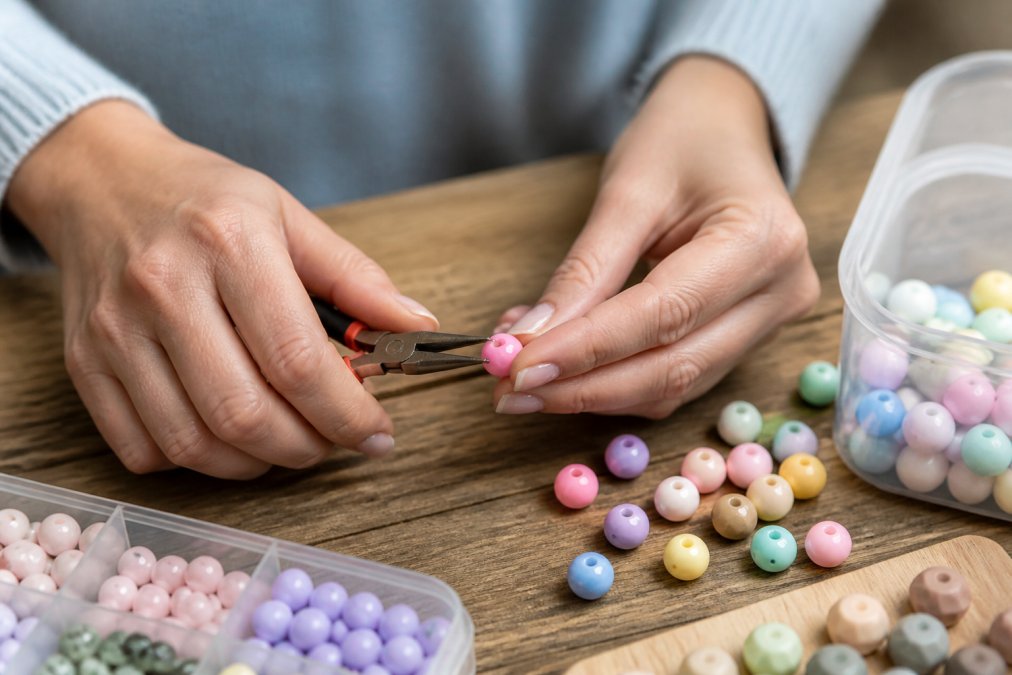
Testing bead quality before you buy means running a small sample through a repeatable protocol that mimics real wear, then logging the results so you can compare suppliers on evidence instead of vibes. A few minutes per batch prevents a shelf full of beads you can't sell.
The Five-Point Intake Test
Run every new batch through the same five checks in the same order. Consistency is what makes the results comparable across suppliers.
- Flex test. Bend a silicone bead between your fingers until the hole nearly closes. It should spring back without a crease or white stress mark. A visible stress mark means the compound is over-filled with filler and will crack at the hole under repeated flexing.
- Finish test. Scratch the surface gently with a fingernail, then rub the spot with a damp cloth. Printed and coated finishes should not flake, lift, or smear. Metallic and glitter finishes are the most likely to fail here.
- Hole check. Run a length of your actual stringing material through the hole and drag it back and forth ten times. Rough or sharp edges will fray thread and wear wire coating over time. This is the single most common cause of premature cord failure.
- Weight check. Weigh ten beads on a kitchen scale accurate to 0.1 oz (nist.gov). Consistent weight across a batch signals consistent density and fewer internal voids. A spread of more than a few percent usually means mixed production lots.
- Water and oil test. Soak one bead overnight in water and rub another with a drop of hand lotion or sunscreen. Fading, tackiness, or a change in texture points to poor colorfastness or a finish that skin oils will break down.
Stress-Testing the Finished Assembly
A durable bead on a weak crimp still fails, so the test that matters most is the one you run on the finished piece. Most guides stop at the bead. Run these three tests on every new design before you list it.
- Drop test. Drop the finished piece from waist height onto a hard floor five times. Check that crimps hold, beads don't crack at the hole, and the finish doesn't chip on impact.
- Tug test. Grip the piece at both ends and pull firmly, the way a child would. Each connection should hold. This is essential for kids' items and cup charms that get yanked off handles.
- Wear-cycle test. Wear or handle a sample piece daily for two weeks. Log any fading, stretching, or finish wear. This is the only test that captures skin oils, sweat, and UV exposure together.
What the Tests Actually Tell You
A flex failure points to the bead compound. A finish failure points to the coating process. A hole failure points to the mold or drill. A weight spread points to inconsistent production. Separating the failure type tells you whether to renegotiate with the supplier, switch suppliers, or simply avoid that color or finish in your line.
Best Places to Buy Crafting Beads for Your Business
The best places to buy crafting beads for a business balance consistent quality, fair pricing, and a return policy you can rely on. Specialty craft suppliers that focus on silicone and acrylic beads can often answer questions about material safety.
When comparing suppliers, ask three questions: Is the material food-grade and BPA-free where relevant? Are colors consistent across reorders? What happens if a batch doesn't work for your project?
For makers who want variety without overbuying, mixed packs and discounted inventory are a practical way to test new colors. The 15 mm Metallic Silicone Beads 20 count mixed and the 15 mm Opal glitter Silicone Beads 20 count mixed both let you sample finishes across a full pack.


| Bead Type | Best For | Watch Out For |
|---|---|---|
| Solid silicone | Keychains, cup charms, kids' items | Lint pickup |
| Printed silicone | Personalized designs | Finish flaking |
| Metallic silicone | Statement pieces | Surface wear |
| Acrylic | High-volume, low-cost designs | Cracking, yellowing |
Matching Stringing Materials to Bead Durability
Stringing material should match bead weight, hole size, and hole texture, or the strongest bead in the world will still fail on a weak cord. The failures that generate returns often happen at the interface between bead and cord, not inside the bead itself. Most guides cover cord types but may not fully address the compatibility question.
Match the Cord to the Bead
| Bead Type | Best Stringing Material | Common Failure If Mismatched |
|---|---|---|
| Silicone (keychains, wristlets) | Coated stainless steel beading wire | Uncoated wire saws through silicone over time |
| Acrylic | Coated beading wire or heavy nylon | Thin thread stretches and beads slide |
| Gemstone and glass | Coated beading wire with crimp beads | Nylon thread frays on sharp hole edges |
| Seed beads | Beading thread or fine nylon | Wire is too stiff and kinks at tight curves |
| Metal components | Coated wire to prevent galvanic reaction | Bare wire corrodes and stains beads |
The Compatibility Problems That Cause Returns
The bead and cord can each be high quality and still fail together. Watch for these specific combinations.
- Sharp-edged glass or crystal beads on nylon thread. The hole edge acts like a blade. Under normal movement the thread frays and snaps, often within weeks. Fix: use coated beading wire, or ream the hole edge before stringing.
- Heavy gemstone beads on thin thread. Weight plus movement stretches thread until it fails. Fix: step up to beading wire rated for the load, and use crimp beads rather than knots.
- Silicone beads on uncoated wire. The wire coating is what protects the silicone from abrasion. Bare wire saws a groove into the bead hole. Fix: always use nylon-coated wire with silicone.
- Metal beads against bare wire in humid conditions. Two dissimilar metals plus moisture create a galvanic reaction that corrodes the wire and stains the bead. Fix: use coated wire, or keep metal components to a single alloy.
- Acrylic beads on stiff wire. Rigid beads on rigid wire crack at the hole under impact. Fix: use a slightly flexible coated wire so the assembly can absorb shock.
A Simple Cord Selection Rule
Match cord diameter to hole size first, then match cord strength to total bead weight. If the cord passes through the hole with a little room to spare and doesn't stretch under the weight of the finished piece, you're in the right range. Keep two or three wire gauges and one spool of beading thread on hand so you can match per project instead of forcing one cord to do everything.
Sustainable and Eco-Friendly Bead Options
Sustainable bead options include recycled glass, fired ceramic, and responsibly sourced materials, and they appeal to buyers who care about where their accessories come from. Recycled glass beads and fired ceramic offer good durability while reducing new material use (the EPA).
Silicone is a practical middle ground: it is long-lasting, which reduces replacement waste, and food-grade formulations avoid many of the additives buyers worry about. For makers building an eco-conscious line, the strongest move is transparency. Tell customers what each bead is made of and why it lasts.
Conclusion
The hardest part of a handmade business isn't design, it's keeping quality consistent across every order. Barkers Creative Designs offers food-safe silicone beads, mixed packs for testing new colors, and discounted inventory. Browse the full catalog of silicone beads, DIY kits, and specialized items like Mini UVDTF to find supplies that hold up in the finished piece. Get started with Barkers Creative Designs and build products your customers keep reaching for.
Frequently Asked Questions
How can I tell if beads are high quality?
Check for uniform size, smooth finish, and no visible seams or cracks. For silicone beads, stretch them slightly; they should return to shape without tearing. Acrylic beads should feel solid, not hollow. Look for certifications like BPA-free and food-grade for silicone. At Barkers Creative Designs, all silicone beads are made from BPA-free, food-safe silicone, so you can trust their quality.
Are silicone or acrylic beads better for long-term durability?
Silicone beads generally outlast acrylic because they resist cracking, fading, and temperature changes. Acrylic can scratch and become brittle over time. For items that get daily wear, like keychains or wristlets, silicone is the more durable choice. However, acrylic offers a glossy finish and lower cost, making it suitable for decorative pieces with less handling.
What kind of beads won't tarnish or fade over time?
Silicone, glass, and natural stone beads resist tarnishing. Metal beads can tarnish unless they are stainless steel or coated. For handmade businesses, silicone beads are a top pick because they hold color well and don't corrode. Acrylic beads may fade with UV exposure, so keep them out of direct sunlight. Always check product descriptions for UV resistance.
How do I choose the right stringing material to match bead durability?
Match the stringing material to bead weight and use. For heavy beads, use strong beading wire with high tensile strength. For lightweight silicone or acrylic beads, nylon-coated wire or elastic cord works well. Consider abrasion resistance: silicone beads can rub against cord, so choose a durable wire. Always test a small sample before assembling the final piece.